Analix Forever

10 Rue du Gothard
1225 Chêne-Bourg
Genève, Suisse
The gallery
Founded in 1991 by Barbara Polla, Analix Forever is an unusual gallery, deploying its projects both within its own walls and in its secret garden, as well as abroad, and favoring collaborations and co-elaborations with multiple players in the world of art and culture. Committed to revealing the essence of the artistic gesture, the gallery values the symbolism and creative processes of the artists it accompanies, and enjoys exploring interfaces, such as between drawing and video, drawing and performance, drawing and painting, drawing and the history of aesthetics, and drawing and new technologies. In 1992, for example, Analix Forever showed computer-generated drawings by the Greek artist Miltos Manetas, a practice that was uncommon at the time, and it's only natural that the gallery should take an interest in the dual manual and virtual practice of Orianne Castel, a doctor in aesthetics who was present at Drawing Now in 2024. Finally, at Analix Forever, the love of art, drawing and poetry included that of words - a lifelong love - and, in January 2025, Analix Forever became a gallery-bookshop, in collaboration with BSN Press.
The project
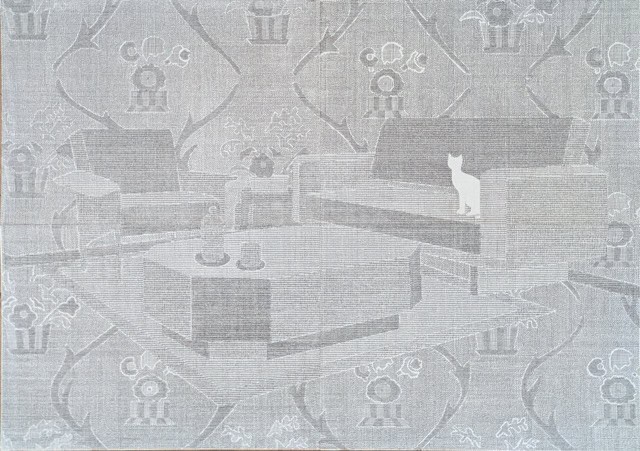
For the Digital sector of Drawing Now Paris, Orianne Castel presents four inks on paper accompanied by their sketches, digital sketches made with a stylus on a smartphone and shown here on a tablet. This work takes the form of a series of homages to the paintings of Vuillard and Matisse, through compositions combining motifs borrowed from their works with views of the artist's interiors.
In the digital sketches, color plays the role of a tool: vivid and immediate, it enables us to quickly organize the composition and test its balance. In the finished drawings, this color disappears in favor of a language of shapes, with the drawing replacing it in a way. Placing them side by side underlines the specificity of the artist's work, in which forms take the place of color.
This substitution is extended by the presentation of several pieces devoted to color. Devoid of actual color, they showcase the artist's formal vocabulary - squares, lines, crosses, then letters - developed over the course of various tributes.